Arborist Services in Cincinnati, Ohio
Connect with local tree care specialists for canopy evaluations, tree health assessments, and structural hazard risk reviews throughout Cincinnati.
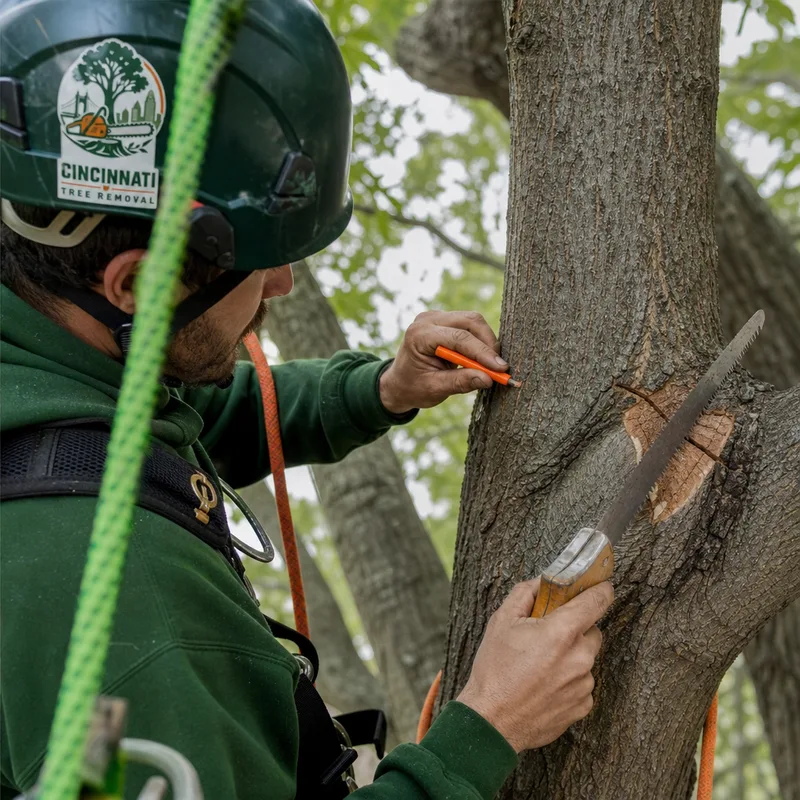
Illustrative tree inspection and branch structure assessment.
What Are Arborist Services & Why Do They Matter?
While standard tree work focuses primarily on cutting, trimming, or hauling away wood, arborist services focus on evaluating tree biology, structural mechanics, and species-specific needs. Property owners often consult specialists when they want an informed, objective assessment before making irreversible removal decisions.
Structural Risk & Target Identification
Assessing whether an aging tree poses an immediate or progressive hazard to houses, driveways, sidewalks, power lines, or adjacent properties.
Pest & Pathogen Diagnostics
Investigating leaf discoloration, canopy thinning, fungal conks, or boring insects to determine if conditions can be mitigated through targeted crown management.
Preservation vs. Removal Guidance
Providing property owners with clear, practical options regarding whether structural cabling, crown reduction, or complete takedown is the most sustainable choice.
Signs a Tree May Need Professional Evaluation
Understanding subtle indicators of internal distress or structural compromise helps Cincinnati homeowners make informed care decisions before high winds or heavy snow cause failure.
Crown Dieback & Deadwood
Noticeable loss of leaves or dead upper branches progressing from the tips inward.
Helps assess vascular system stress, root compromise, or fungal pathogens before limbs become brittle hazards.
Trunk Cavities & Decay Conks
Hollow cavities, woodpecker holes, split seams, or bracket shelf fungi growing on bark.
Indicates active internal wood decay, compromising the structural column under high wind shear.
Root Flare Damage & Fungal Clusters
Mushroom clusters around the base of the trunk or soil mounding/heaving on one side.
Signals potential root rot, severed anchor roots, or soil failure that threatens tree stability.
Co-Dominant Stems with Included Bark
Two or more main leaders growing tightly together in a 'V' shape rather than a strong 'U' union.
Trapped bark prevents wood fibers from bonding, creating a natural fracture line under heavy ice or wind load.
Sudden Ground Lean After Saturation
A previously straight tree noticeably tipping, with cracked or lifted turf opposite the lean.
A critical indicator that root anchorage has failed in saturated Cincinnati clay soils.
Construction Trenching & Compaction
Excavation, driveway paving, or heavy machinery operating inside the tree's critical root radius.
Identifies severe root damage that often manifests as slow decline or sudden instability years later.
Trimming vs. Tree Removal: How Factors Align
Before concluding that a declining tree must be cut down, property owners can evaluate these structural factors with a tree specialist.
| Assessment Factor | When Pruning / Care May Suffice | When Removal Is Often Indicated |
|---|---|---|
| Canopy Vitality | More than 70% of the live crown is healthy and vigorous with intact leaf density. | Severe crown dieback exceeds 30-50% with widespread dead branch structure. |
| Trunk Integrity | Solid sound wood with minimal surface wounds or healthy wound-wood closure. | Extensive internal hollows, longitudinal vertical cracks, or rotting heartwood. |
| Proximity to Targets | Branches can be safely cleared from roofs, gutters, and walls with selective reduction cuts. | The trunk leans heavily over living spaces, decks, or high-traffic areas with compromised anchor roots. |
| Root System Stability | Undisturbed root flare with firm soil anchorage and no signs of soil lifting. | Severe root severance from trenching, severed major tap/lateral roots, or base fungal rot. |
| Species & Life Stage | Long-lived, structurally durable species with decades of expected canopy longevity. | Short-lived, brittle, or invasive species prone to storm failure and ongoing structural decay. |
How Local Tree Specialists Conduct Evaluations
A systematic inspection examines a tree from the ground up, identifying vulnerabilities that might otherwise remain invisible until adverse weather occurs.
Roots & Soil Foundation
Evaluates soil compaction, grading alterations, trenching wounds, and visible root flare defects such as girdling roots or subterranean fungal decay that threaten stability.
Trunk & Branch Architecture
Inspects the main stem for decay cavities, vertical seam cracks, co-dominant stems with included bark, and previous pruning wounds that may have failed to compartmentalize.
Canopy Vitality & Targets
Checks leaf density, annual growth rates, deadwood accumulation, and proximity to living spaces, utility service drops, garages, or pedestrian access paths.
Next Steps After Tree Evaluation
Depending on what an evaluation reveals, explore related tree services to execute the appropriate care or takedown plan.
Tree Trimming
Crown reduction, selective pruning, and clearance trimming.
View TrimmingTree Removal
Complete sectional dismantling for dead or hazardous trees.
View RemovalStump Removal
Mechanical below-grade grinding after tree takedowns.
View Stump GrindingEmergency Tree Removal
Urgent response coordination for compromised or split trees.
View Emergency InfoFrequently Asked Questions About Arborist Services
Clear, informational answers regarding tree evaluations, inspection scope, and cost factors in Cincinnati.
Have concerns about a declining tree or leaning canopy?
Call About Arborist Services ((513) 650-7651)Connect with Tree Care Specialists in Cincinnati
Call now to discuss tree evaluations, health assessments, trimming, or removal coordination in Cincinnati, Ohio 45244.